If you can't hear the difference, it doesn't matter, right ?
WRONG.
"People will only ever listen to the mp3, so it doesn't matter"
"I can't hear any distortion - so it doesn't matter"
"You can't hear it on earbuds - so it doesn't matter"
Or, the ultimate:
"If it sounds right, it is right"
So, am I saying that's not true ?
Not exactly. What I'm saying is:
Your monitoring might hiding things from you, and you could be making decisions you'll regret later
Of course, I can't. But what I can do is give you an analogy.
Take a look at the video above, especially at the before and after shots at 40 seconds in.
If you're like me, there's not that much difference !
In fact, the first time I watched it, I thought the "Before" looked superficically better - brighter, richer colours, more contrast. In comparison, the HD "after" version looked washed-out and softer.
BUT
On the YouTube page, click the "Fullscreen" icon, and then select "1080p" from the Quality "gear" menu.

(You may have to await a while for the larger HD stream to buffer and start playing, depending on your broadband speed.)
Now watch from 40 seconds in again.
If you're like me, you just radically changed your opinion !
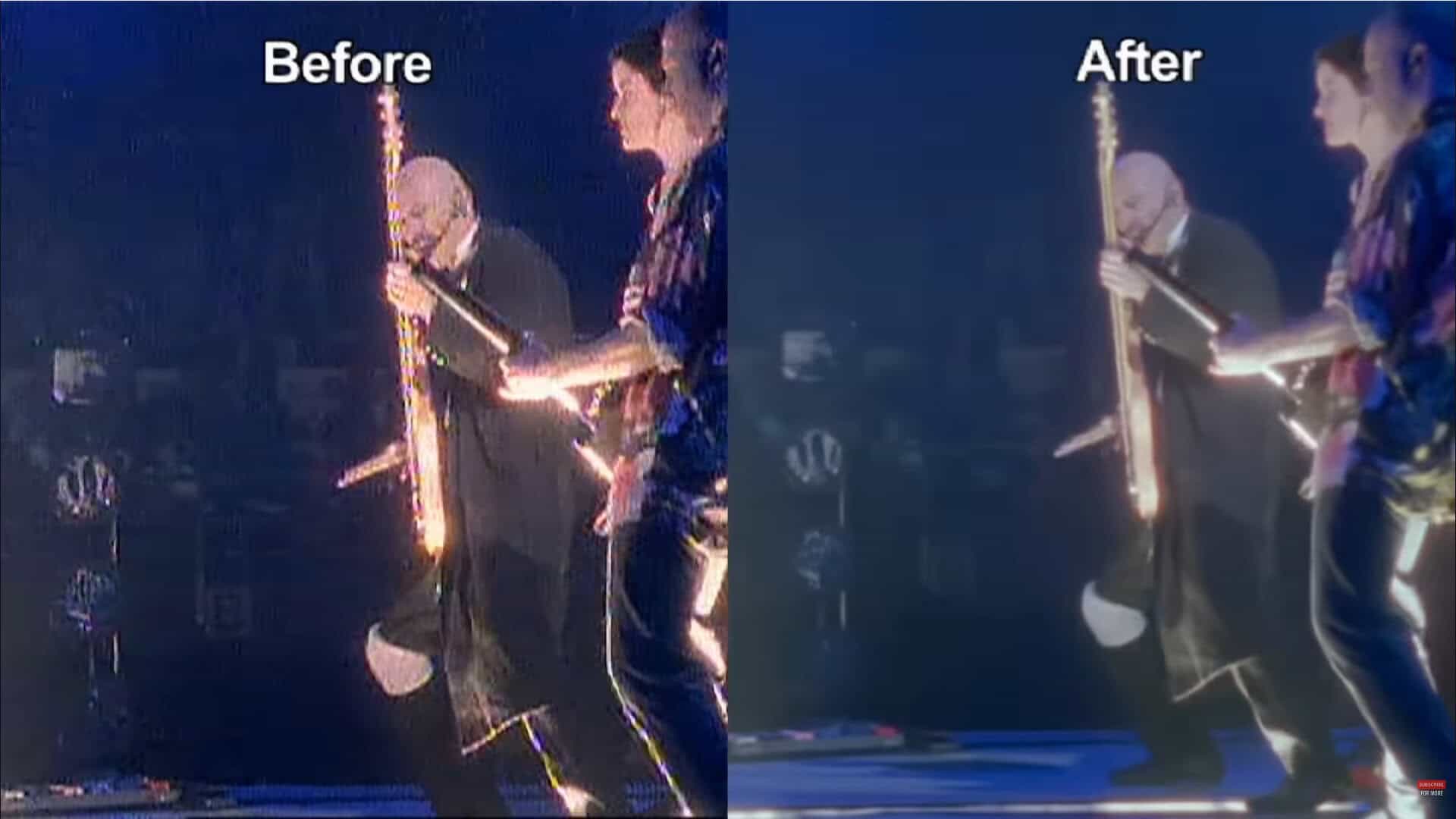
The "before" looks terrible - noisy, pixelated, over-saturated - just bad. (Click on the image below if you don't believe me)
You improved the quality of your monitoring.
The small, low-bandwidth YouTube window hid all the flaws in the "before" video, and at the same time reduced the quality of the "after" version, making it look worse than it really is.
Low-quality monitoring impaired your ability to make a fair assessment of the importance of the differences. It made stuff that really matters almost invisible.
By using the HD version, you didn't actually upgrade your computer monitor, but it seems like you did - watching the normal YouTube window is like trying to paint your hall through a letterbox in the door, but with the fullscreen HD stream you're getting the full benefit of the screen you already have.
Now imagine the difference you'd notice watching the same thing on a 72" wall-mounted display !
Audio works in exactly the same way.
Judging the quality of the video in a normal YouTube box is like trying to assess audio quality by listening to an mp3 on earbuds
And yes, people really do that ! Several times a week someone emails me or comments on a video saying "but shouldn't we be optimising our masters for iPhone earbuds?".
NO.
It is important to know how our stuff sounds on low-end systems, but that's not where we should make final decisions about quality.
Imagine trying to watch that video on your laptop, sitting in the garden with the sun on your screen. The reflections would be a nightmare.
Just like listening to your music in a room with no acoustic treatment, and all the refections bouncing off the bare walls…
You need the highest-quality monitoring you can lay your hands on - for both audio and video.
By all means check how your stuff sounds on crappy equipment - but don't make your final decisions there.
Because it's true that "if it sounds right, it is right" - but if your monitoring and environment are hiding the truth from you, you have no idea how it really sounds.
Just because you can't hear it doesn't mean it doesn't matter...
Just to avoid any possible confusion, I'm not talking about tiny subtle details in this post - to me, the differences in the picture quality in that video are easy to see. And in the same way, people miss easy-to-hear problems with their audio all the time, because their monitoring isn't up to scratch - faults like blatant clipping distortion or poor EQ balance, for example.
And I'm not coming from some elitist mastering pie-in-the-sky point-of-view here, either - even the right pair of $500 hi-fi speakers can be good enough to hear 95% of the true sound of your audio, in a decent room with a little treatment...
High-quality monitoring is a key part of mastering, but not everyone can afford the best speakers in the world. That doesn't mean you can't get great results mastering at home, though - there are several ideas and strategies you can use that I discuss in my courses - for more information, click here.