I'm seeing this question all the time recently:
"I hit the LUFS target, but my mixes still sound smaller than the pros - WTF?!"
Which seems like a perfectly reasonable question, right ? LUFS measure loudness, so just match the LUFS to the appropriate target and you're good to go… why wouldn't it work ?
Well (as always) it's not quite that simple.
Yes, LUFS attempt to measure loudness, but it's just a number, like anything else. It has distinct limitations - and it makes for a pretty hopeless target.
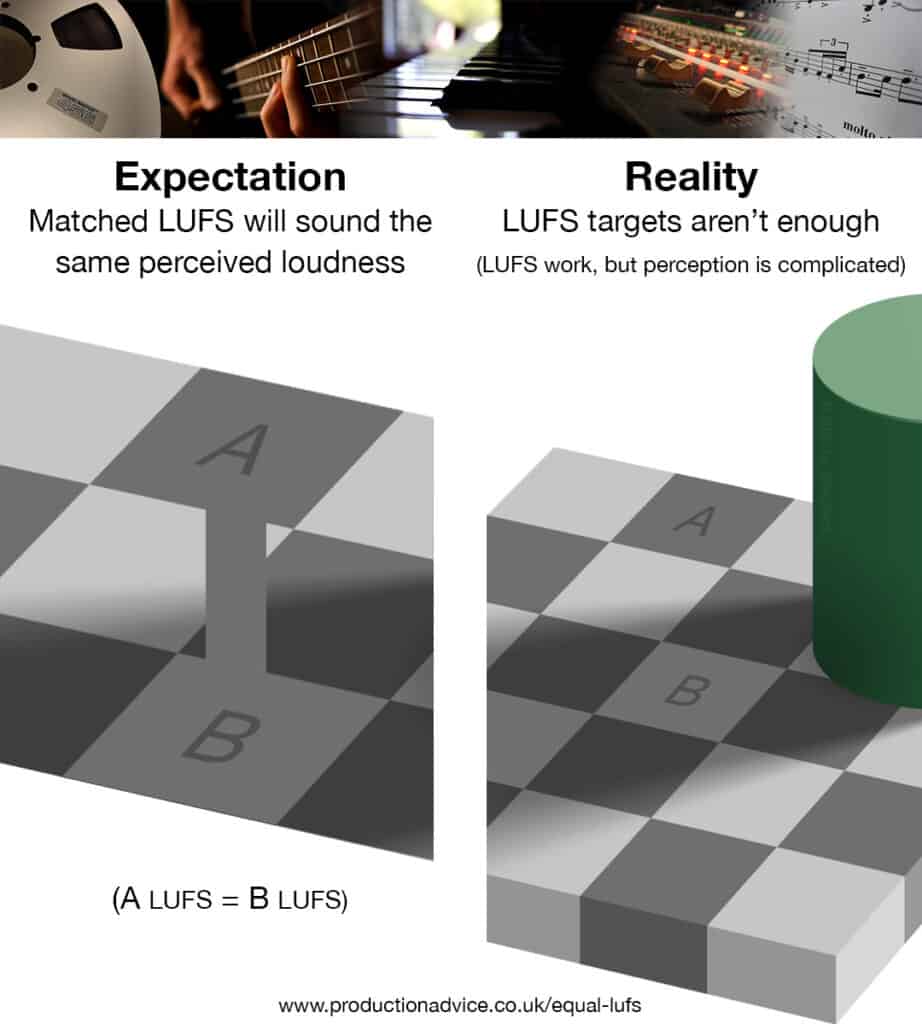
The infographic above tries to show this, using a visual analogy. You might have seen the optical illusion it's based on before – squares A and B on the chess board are actually exactly the same measured colour, as you can see in the zoomed-in version on the left, where I've joined them together to make it even clearer.
But in the zoomed-out version on the right, it seems impossible to believe. Our brains look at the context and decide that the white square can't possibly be the same colour - the black square seems obviously darker.
But they really are – I've checked the values myself in Photoshop. Even the letters A and B inside the squares are the same colour...! And even though I know that, I still see them as different colours, just like you. Perception is complicated – remember The Dress ?!
And something very similar can happen with audio. Even though two sounds measure exactly the same LUFS, we perceive them as having different loudness.
There's a whole range of reasons this can happen, but the short version is:
Context
In the context of the shaded chess board, we perceive A as being darker than B.
In the context of an album or playlist, we may perceive two songs with the exact same LUFS as being different in loudness.
But here's the thing, though:
I see loads of people experimenting with LUFS, and getting frustrated that it doesn't work the way they expect, and concluding that the measurement and even whole concept of loudness-matching is broken. Which unfortunately causes huge frustration, as Russ Hughes pointed out on the Production Expert site just this week.
And I completely get that. As I've said many times, aiming at LUFS targets when mixing or mastering is not a strategy that you're likely to find very useful.
But the measurement does work reasonably well, for a wide range of material – especially given its age and the fairly simple method used.
Try disabling Sound Check on Apple Music, or the default normalisation in Spotify to see what I mean – the loudness matching is far from perfect, but it's way better than nothing.
(And remember, over 80% of music fans listen with normalisation enabled and don't even realise, unlike most of us in music & audio production.)
I completely understand the frustration with LUFS, but expecting a simple measurement to account for the detailed psychoacoustics of musical perception is a pretty bigger ask. It might be possible using modern tech, but when LUFS was introduced those tools didn't even exist – and they needed to run on very low-spec devices.
In the same way, simply measuring the colour-value of the pixels in the chessboard image can't take account of the complicated way we perceive the image - but this doesn't mean that measuring the colour in this way is broken or flawed. We just have to be careful with how we interpret both results.
Maybe better solutions will come along eventually, but for the foreseeable future LUFS is what we have for audio – and it does a decent job, much of the time.
So my suggestion is to follow musical methods for determining the loudness of our masters rather than trying to use LUFS targets – and then test carefully to make sure it has the result you're hoping for, both with and without loudness-matching.
It's the strategy I've been using my entire career, and it still works – regardless of the LUFS you choose to master at. Higher and lower levels each come with their own challenges, but it doesn't really matter what LUFS level you choose to master at - what matters is how you achieve that level, and all the other decisions you make afterwards follow from that decision.